A battery pack line quotation carries six numbers that decide what the plant owner is buying: a takt, a floor area, a power figure, an annual output, a headcount and a yield promise. Each fixes something in the building, the utilities contract or the acceptance protocol, and each is easy to misread if the quotation does not say how it was counted. This note says what each is measured against.
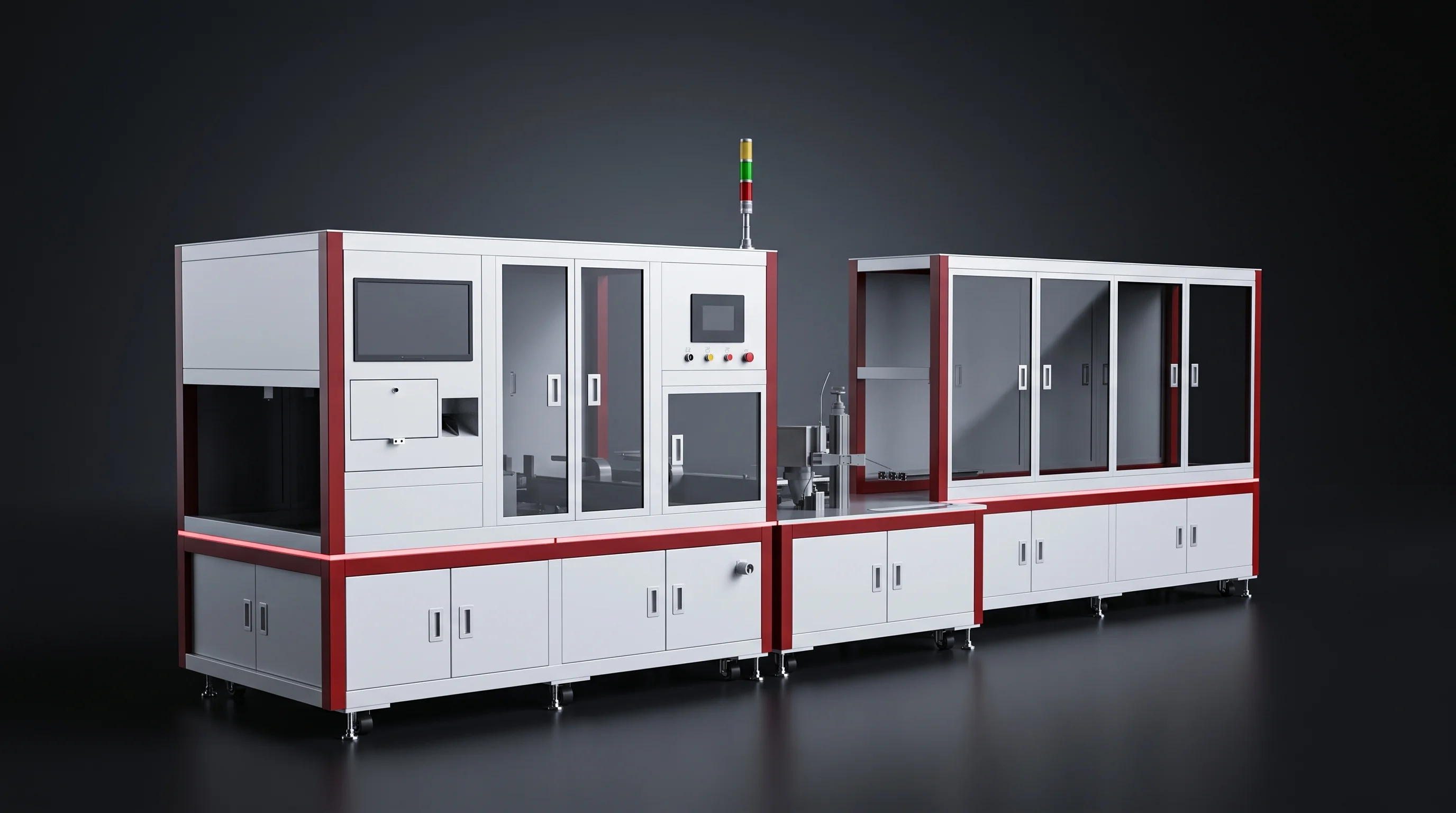
PPM counts cells at the loading station, not finished packs
The first number is the takt, written in PPM. On this site PPM means pieces per minute, and the piece is one cell entering the module segment at the cell de-tray loading station. It is not finished packs per minute and it is not modules per minute. The distinction matters because the line has 17 stations in the module segment and 15 stations in the pack segment, and the pack segment runs on larger units: with the baseline 1P13S module and 1P52S pack, a takt quoted in cells reads very differently from one quoted in packs.
The three line tiers are separated on this cell-level takt: BLP-P8S at 4–8 PPM, BLP-P8 at 8 PPM and BLP-P15 at 12–15 PPM. At the site acceptance test PPM is counted at the same loading point, so the quotation and the SAT report carry the same measurement. The tier selection page sets out what each takt changes downstream.
Annual capacity in GWh follows from PPM by one public formula
The second number is annual output, and it is derived, not measured. The formula is printed so a project owner can recompute it: annual capacity = PPM × 60 min × 8 h × 300 days × 1.005 kWh per cell × 0.85 availability. The 1.005 kWh is the baseline 314 Ah prismatic cell at 3.2 V LFP nominal. Applied across each tier’s takt band, the result is 500 MWh – 1 GWh per year for BLP-P8S and 1 – 2 GWh per year for BLP-P15. For BLP-P8 the annual figure is given on request against the customer’s cell and shift pattern.
What changes the answer
Three inputs move the result: cell energy, shift pattern and availability. A plant running a 280 Ah cell, or more than 8 h per day, or more than 300 days per year, lands outside the printed bands, which is why the quotation states the assumptions next to the figure.
| Tier | Takt | Footprint L × W × H | Rated power | Annual capacity |
|---|---|---|---|---|
| BLP-P8S | 4–8 PPM | 56 × 10 × 4 m | 200 kW | 500 MWh – 1 GWh |
| BLP-P8 | 8 PPM | 55 × 9 × 3.5 m | ≤250 kW | On request |
| BLP-P15 | 12–15 PPM | 54 × 20 × 4 m | 300 kW | 1 – 2 GWh |
Footprint is a bay, and the bay has a clear height
The third number is the floor area, quoted as length, width and height: 56 × 10 × 4 m for BLP-P8S, 55 × 9 × 3.5 m for BLP-P8 and 54 × 20 × 4 m for BLP-P15. The height is a clear height under the lowest obstruction, not to the roof. As a general observation, ceiling services such as trays, sprinklers and ducting typically take 300–500 mm, so a building with 4 m to the beam often leaves 3.6 m usable; measure it before comparing the quotation against the drawing.
The floor under the line has to carry ≥800 kg/m². The layout is adjustable to the customer’s building; the quoted rectangle is the reference arrangement, and the layout and utilities page shows how the segments are re-drawn on a different column grid.
Utilities: power, compressed air and nitrogen per tier
The fourth number is really a small set. Rated power is 200 kW for BLP-P8S, ≤250 kW for BLP-P8 and 300 kW for BLP-P15, on a 3-phase 5-wire 380 V ±5%, 50 Hz supply. Compressed air is 0.5–0.7 MPa at 3500 / 3000 / 5500 L/min for P8S / P8 / P15. The economy tier draws more air than the standard tier; that is the tier specification, not a typo, and the air contract should be sized to it. Nitrogen for the laser welding station is 0.5 MPa at 20–40 / 40 / 40–80 L/min in the same order.
Why the nitrogen line is on the quotation at all
The busbar welding station, BLP-W6, runs a 6 kW laser at 50–100 mm/s and is accepted on penetration ≥1.0 mm, weld width ≥1.5 mm and a pull force ≥1000 N. Shielding gas flow is part of the stored weld recipe, so nitrogen is a process input, not a facility convenience. The busbar welding station page describes the recipe and the post-weld check.
Headcount by segment, and why the pack segment is manual-heavy
The fifth number is people per shift, quoted per segment. BLP-P8S runs with 4 in cell handling, 4 in module welding and 12–14 in pack assembly; BLP-P15 runs with 4, 3 and 12–14. The pack segment carries most of the headcount because most of its stations are manual: module fixing, busbar and BMS installation, harness dressing and lid fitting are done by hand on both tiers, with automatic stations at gluing, leak testing and end-of-line test. A quotation showing a low pack-segment headcount without saying which of those stations it automated is describing a different line.
The headcount on a quotation is only honest when it is printed next to the station list that explains it.
Yield ≥99% and what the acceptance test measures
The sixth number is the yield promise: ≥99%, counted on equipment-caused defects only, human factors excluded in writing. The definition behind it is availability = time availability × performance availability × first-pass yield, and yield = (input − NG) / input. Acceptance criteria are written per station and signed by both parties before the line ships, which is where the six numbers stop being a proposal and become a test plan.
- FAT runs in our pre-assembly bay with the customer’s own cells, busbars, end plates, enclosures and cooling plates: 4 hours continuous run, then 20 modules and 5 packs through every test item, over 2–3 working days.
- SAT runs after installation: 8 hours continuous at the target takt, counted at the loading point, with equipment-caused yield ≥99%, weld pull samples ≥1000 N and the full module EOL items, over 3–5 working days.
- Module EOL holds insulation at DC 1000 V to ≥500 MΩ and hipot at DC 2800 V with leakage ≤10 mA; the end-of-line testing page lists every gate.
The eight-step sequence from criteria signature to training is on the FAT and SAT acceptance page. To have these six numbers written against your own cell format, target output and bay, send the basics through the contact page; an engineer replies within 24 hours.
